

The doors open and the queue starts
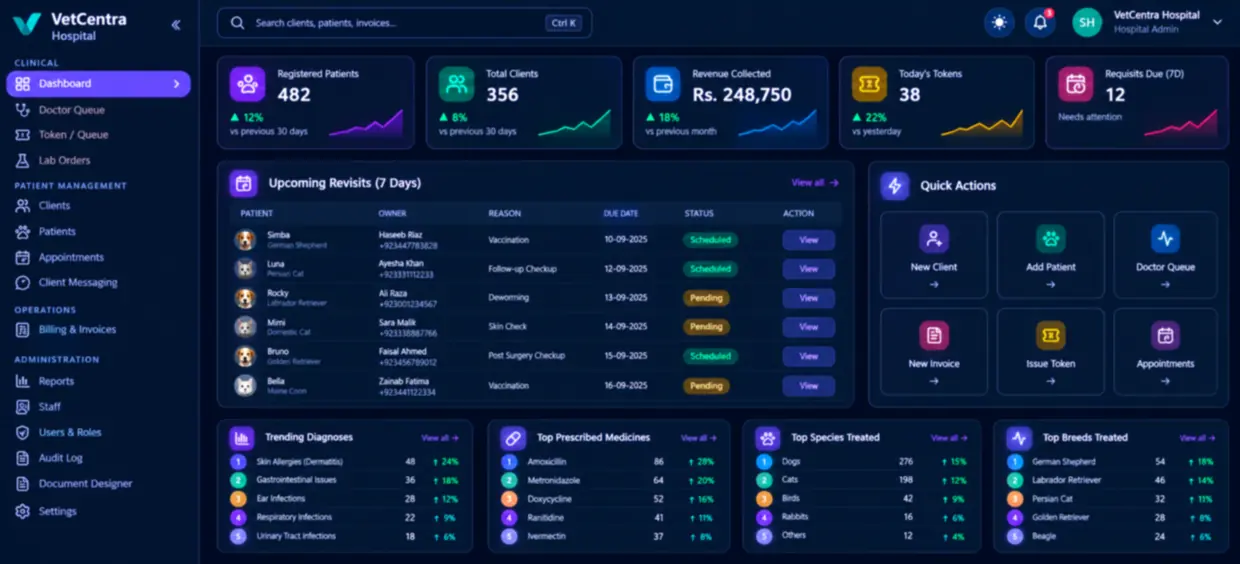
The front desk registers a walk-in and prints a token in one action. The screen shows who is next, what they came for, and how long each person has actually been sitting there.
Token queue, medical records, prescriptions, laboratory, stock, billing and WhatsApp reminders in one browser-based system — with your printer, your tax line, and your species list.
58 & 80 mm thermal + A4Dogs to dairy buffaloPKR, your tax wording

Not a dashboard nobody opens. The parts of the day that actually need software, and how each is handled.
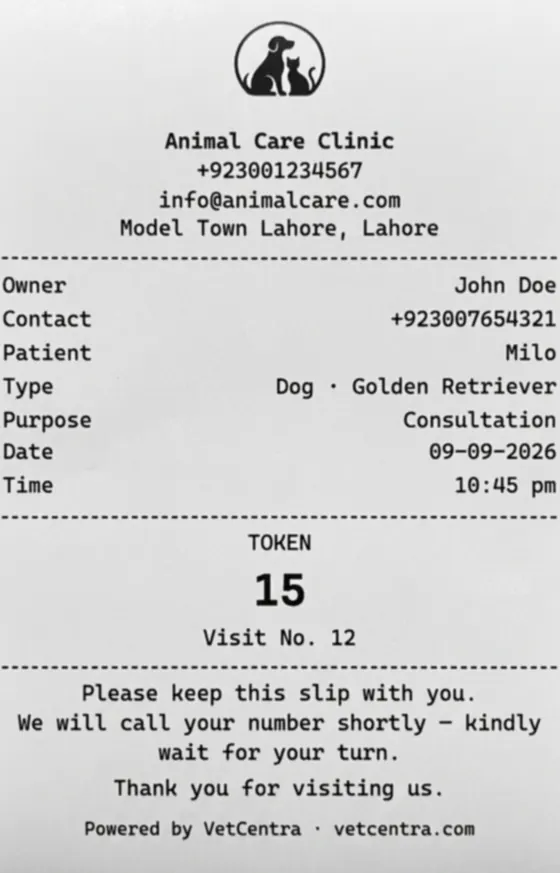
Walk-in registered and token printed in one action. Waiting time counts from the moment the slip came off the roll — the question a front desk is asked all morning.

A consultation cannot be deleted. Corrections void and amend; the original stays readable, with who changed it and when. Forms are yours to configure, field by field.
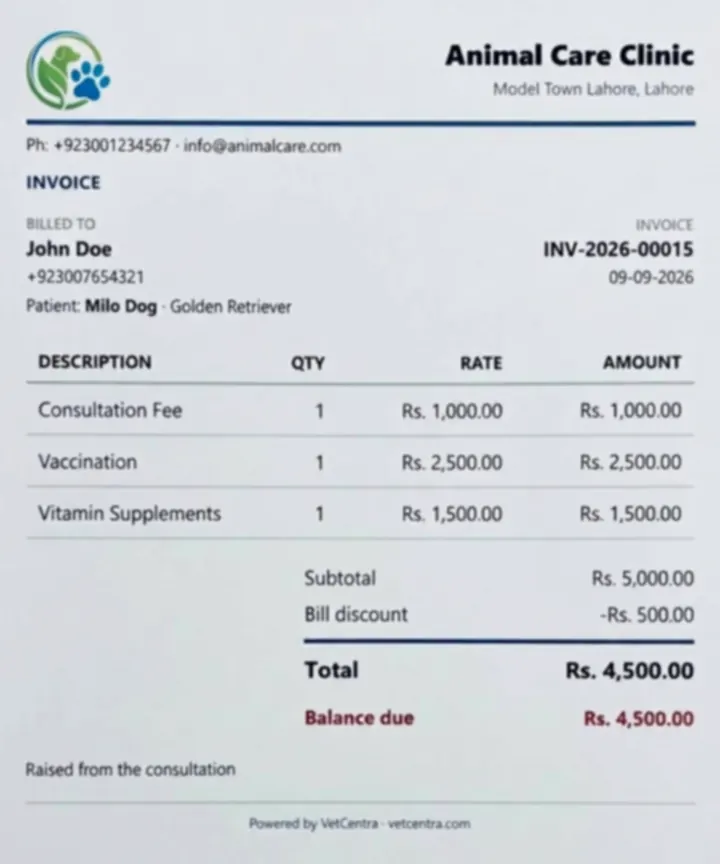
Name the tax, set the rate, label the registration number. Gapless invoice numbering enforced by the database. Roll and A4 as two proper layouts.
Vaccination and follow-up worklists, templates in the clinic's words and the owner's language, documents as links. No QR-scanning blasters that get numbers banned.
Printed wallet card with a QR code. Scan it and the animal's record opens — no app, no account, no password. Portal logins for owners who want one.
Forms, roles, templates, tax and catalogue are yours to set. Need something beyond that? If the requirement is sound, we build it for your practice.
Every clinic's rows are isolated by PostgreSQL row-level security and proven by an automated check before each deployment.
Interactive — click through the parts of a working morning.
A token is issued against a real patient, so a slip can never be printed for another clinic’s animal — or for one that has been marked deceased.
We do not put AI on a button because it is fashionable. It goes where a vet loses time or a clinic loses sight of what is happening.
Counts come from your own consultations — nothing is estimated.
A roll is a continuous strip with no page margins. A sheet has margins and table headers that repeat. Most systems shrink one to fit the other and clip the right-hand column. VetCentra declares both layouts separately and tests them separately.
The token slip carries the clinic's own logo, the owner's number, the animal, the purpose and the queue position. The invoice carries your tax line, your registration label and a number that is never reused.


Most practice software is written for a booked-appointment clinic in another country. A busy practice in Lahore or Karachi runs on walk-ins, a waiting room, and a phone that never stops.
The front desk registers a walk-in and prints a token in one action. The screen shows who is next, what they came for, and how long each person has actually been sitting there.
The consultation form is the clinic’s own. Every field is set by the practice, not by us: required, optional, or hidden. History, weight trend and past prescriptions sit on the same screen.
Medicines come off the clinic’s own catalogue with dose and duration. Dispensing writes the stock movement, so the shelf count and the record never drift apart.
The invoice picks up everything from the visit. It prints on the 58 or 80 mm roll on the counter, or on A4 for a corporate client, with the practice’s own tax line and registration number.
Vaccination due, a report ready, a follow-up. Messages are built from the clinic’s own templates and open in WhatsApp with the text prepared and the document attached as a link.
The international systems are good software. They were designed for practices with booked appointments, card terminals, insurance claims and email.
Reminders, reports and invoices go out on WhatsApp because that is where owners in Pakistan actually read them. Templates are the clinic’s own words, not ours.
58 mm and 80 mm thermal rolls for tokens and receipts, A4 for prescriptions and corporate invoices. Both layouts are handled properly, not by shrinking one to fit the other.
Prices in PKR, a tax line you name and rate yourself, CNIC on staff records, and phone numbers stored in one shape so 0300 1234567 and +92 300 1234567 are one owner, not two.
Species are a list the platform maintains, not a dropdown with two entries. A practice that sees buffalo in the morning and a Persian cat in the afternoon is an ordinary practice here.
| A paper register | International cloud PIMS | VetCentraBuilt in Lahore | |
|---|---|---|---|
| Finding a returning patient | Depends on who is at the desk and how the file was written | Instant, if the owner was entered consistently | Instant. Numbers are stored in one canonical shape, so 0300 and +92 300 are the same owner |
| Reaching the owner again | A phone call, if someone remembers | Email and SMS reminders | WhatsApp worklists, in the language that client reads, with the document as a link |
| Printing on the counter | A duplicate book | A4 assumed; roll support varies | 58 mm and 80 mm rolls and A4, as two properly separate layouts |
| Tax on the invoice | Written by hand | Usually a fixed regime for the vendor’s home market | You name the tax, set the rate and the registration label. Issued invoices keep the rate they were issued under |
| Species you can record | Whatever you write | Companion animals; livestock often an afterthought | Cattle, buffalo, goats, poultry and equine are first-class, on a maintained list |
| Correcting a mistake | Crossed out, or rewritten | Usually editable, sometimes with a log | Records cannot be deleted. Corrections void and amend, and the original stays readable |
| Stock matching the shelf | A separate register, reconciled monthly at best | Tracked, and usually editable | Balances derived from movements that cannot be edited or deleted |
| Setting it up | Nothing to set up | Weeks, and often a paid implementation | An afternoon over WhatsApp, or in person if you are in Lahore |
Most of what goes wrong in a clinic system is ordinary — a wrong figure typed, a permission left on, a record deleted in a hurry.
Every record carries the clinic it belongs to, and PostgreSQL refuses to return another practice’s rows even when a query asks for them. Not a filter in application code that a future change might forget.
A consultation cannot be deleted. Stock movements cannot be edited. Payments and credit notes are insert-only. Invoice numbers are gapless and never reused, enforced by database triggers.
Roles and per-person permissions are the clinic’s own. Anything that narrows access — a role change, a deactivation, a password reset — ends that person’s active sessions rather than waiting for a token to expire.
Who did what, and when. That includes us: if support signs in to your clinic to help, the visit is written into your audit log and a bar sits across the top of the screen for the whole session.
Comparing vendors? Ask each whether tenant separation is enforced in the database or in application code, and whether an automated test proves it. How ours works.
Consultation forms, roles, message templates, tax wording, visit purposes and the medicine catalogue are all set by the clinic, from the screen, without a ticket. When a practice needs something beyond that — a report, a workflow, an integration — we build it, provided the requirement is sound and useful. Describe it on WhatsApp and we will tell you honestly whether it makes sense.
Nobody shuts a clinic for a weekend, and nobody types twenty years of files.
Tell us how your clinic actually runs — how many vets, what you see, what you print. If we are the wrong fit we will say so on that call rather than after you have paid.
Your medicine catalogue and prices, your visit purposes, your consultation form, your staff logins and permissions, your invoice layout with your own tax wording. In Lahore we do this at your desk.
Start with the queue and the patient register, keeping the paper register alongside. The register fills itself as a side effect of ordinary work, and the front desk learns the software doing something simple.
Consultations in week two, prescriptions and billing in week three, vaccination reminders in week four — once there are enough records to remind anybody about.
Also running in Faisalabad, Multan, Peshawar, Sialkot, Gujranwala and Quetta — and outside Pakistan, where currency, tax and phone formats are simply set differently.
It is the system a clinic uses instead of a paper register: appointments and tokens, patient and owner records, consultations and prescriptions, laboratory results, medicine stock, billing, and communication with owners. Everything sits in one record per animal, so any vet in the practice can open a file and see what has happened before.
Yes. It was built in Lahore around how practices here run. Prices are in Pakistani rupees, the tax line and registration label are configured by the clinic, phone numbers follow local formats, CNIC is a field on staff records, and reminders go out on WhatsApp. Thermal roll printing works with the 58 mm and 80 mm printers already on most counters.
Yes. Species come from a maintained list that includes cattle, buffalo, goats, poultry and horses alongside dogs and cats. The consultation form is defined by the clinic, so a practice doing farm work can ask for what it needs and hide what it does not.
No. Owners can sign in to a web portal to see their own animals’ visits, vaccinations and documents. They can also simply scan the QR code on the pet’s printed ID card, which opens the record without any account at all.
Most clinics start by entering active patients as they walk in, which spreads the work across a few weeks and avoids a shutdown. If you have records in a spreadsheet or another system, send us a sample and we will tell you honestly whether importing them is worth doing.
Yes, and it is enforced by the database rather than by application code. Every record carries the clinic it belongs to, and PostgreSQL row-level security refuses to return another practice’s rows even if a query asks for them. There is an automated check that proves the isolation holds, and it runs against every deployment.
Yes. Each branch keeps its own patients, stock and takings, and staff see only the branch they belong to. Reporting can be read per branch or across all of them.
Yes. Country, currency, timezone, phone format and whether a national ID is even asked for are all set when the clinic is created, and nothing in the software assumes one country’s rules. Clinics in the Gulf and the UK run the same product.
Send a message and we will walk through your actual front desk — the queue, the register, the printer on the counter — and show you what changes. No presentation, no obligation.